Furniture markup is the amount a retailer adds to the cost of a piece to reach its selling price. Most furniture stores price at 2 to 3 times their cost, which is a markup of 100% to 200%. This guide covers the formula, the difference between markup and margin, the usual ranges, the costs a price has to carry, landed cost, a 5-step pricing method, and the effect of discounts.
The numbers to remember:
- Markup % = (retail price − cost) ÷ cost × 100.
- Keystone pricing means 2 × cost: a 100% markup and a 50% gross margin.
- Price from landed cost (wholesale + freight + damage allowance), not from the wholesale price alone.
- A 20% discount on a 2.5 × price leaves you at exactly 2 × cost.
What Furniture Markup Is
Markup is the difference between what a piece costs you and what you sell it for, expressed as a percentage of the cost. The formula is:
Markup % = (retail price − cost) ÷ cost × 100
A dining set that costs you $1,500 and sells for $3,300 carries a markup of 120%: the $1,800 difference divided by the $1,500 cost. Retailers also describe the same price as a multiplier. In this example the multiplier is 2.2, because $3,300 is 2.2 times $1,500.
The cost in the formula is your full cost to get the piece onto the floor. A supplier’s price sheet is only the first part of it, which is why choosing a wholesale furniture supplier on list price alone gives the wrong answer.
Markup vs. Margin: Two Numbers From One Price
Markup measures profit against cost, and margin measures the same profit against the selling price. The two percentages are never equal, and mixing them up is the most common pricing error in retail. A 100% markup is a 50% margin, not a 100% profit.
| Multiplier | Markup on cost | Gross margin on price | Cost $1,000 sells for |
|---|---|---|---|
| 1.5 × | 50% | 33.3% | $1,500 |
| 2.0 × (keystone) | 100% | 50.0% | $2,000 |
| 2.2 × | 120% | 54.5% | $2,200 |
| 2.5 × | 150% | 60.0% | $2,500 |
| 3.0 × | 200% | 66.7% | $3,000 |
To convert, use margin = markup ÷ (100 + markup) × 100. Your accountant and your lender talk in margin. Your price tags are built with markup. Know both for every category you sell.
Typical Furniture Markup Ranges
Furniture retailers most often price between 2 and 3 times cost. No official figure exists, and the right number depends on the store, yet three levels come up again and again in the trade:
- 2.0 × (keystone): the traditional starting point. It works for stores with low overhead and few promotions.
- 2.2 × to 2.5 ×: common for full-service stores that deliver, assemble and carry floor samples.
- Up to 3.0 ×: used by stores that run frequent sales, so the discounted price still lands near keystone.
Interior designers who resell to clients work differently. They usually add a smaller percentage to the trade price because they carry no showroom and no inventory.
What the Markup Has to Cover
A furniture markup pays for everything between the supplier’s dock and the customer’s living room. Furniture needs a higher multiplier than most retail goods for one reason: it is large and it sells slowly. A sofa set occupies about 100 square feet of showroom for weeks before it sells.
The gross margin on each sale has to carry these 7 costs:
- rent and utilities for a large showroom and a warehouse;
- sales commissions and staff wages;
- delivery, assembly and returns;
- damaged pieces and floor samples sold at a loss;
- card processing and customer financing fees;
- advertising;
- markdowns on pieces that do not sell.
What remains after those costs is net profit, and it is a small share of the selling price. That is why a store that discounts below keystone on every sale does not stay open.
Start From Landed Cost, Not From the Wholesale Price
Landed cost is the wholesale price plus everything you pay to get the piece to your floor in sellable condition. Price from the landed cost, because freight and damage come out of your margin whether you count them or not.
Here is a worked example for one 3-piece sofa set:
| Item | Amount |
|---|---|
| Wholesale price | $1,200 |
| Freight to your store | $120 |
| Damage allowance (2.5% of wholesale) | $30 |
| Landed cost | $1,350 |
| Retail price at 2.2 × | $2,970 |
| Gross margin | $1,620 (54.5%) |
The same set priced at 2.2 times the wholesale price alone would sell for $2,640. The margin would then fall to 48.9%, which is below keystone. The figures are an illustration: replace them with your own freight quotes and your own damage rate from the last 12 months.
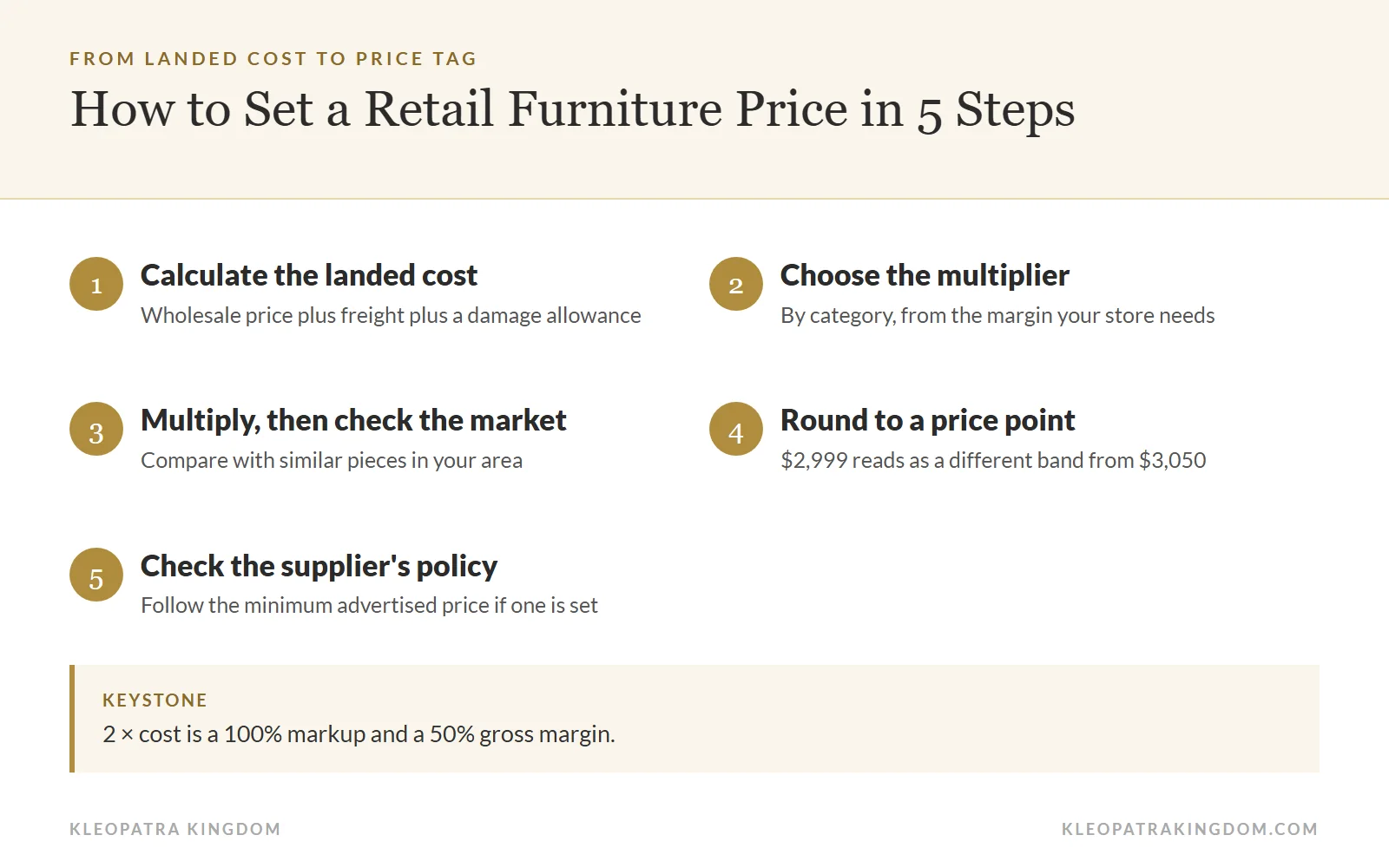
How to Set a Retail Price in 5 Steps
- Calculate the landed cost of the piece or the set, as in the table above.
- Choose the multiplier for the category. Use the margin your store needs to cover overhead, not the multiplier a competitor uses.
- Multiply, then check the market. Compare the result with what similar pieces sell for in your area.
- Round to a price point. Customers read $2,999 as a different band from $3,050.
- Check the supplier’s policy. Follow the minimum advertised price if the supplier sets one.
If step 3 shows that your market does not accept the price, the piece does not fit your store at that cost. Negotiate the cost or choose another collection. Do not solve it by giving up the margin.
Markup by Furniture Category
One multiplier for the whole store leaves money on the table. Categories differ in ticket size, in how easily customers compare prices, and in how often they are damaged.
| Category | Typical approach | Reason |
|---|---|---|
| Living room and dining sets | At or slightly above keystone | High ticket, compared across stores, often promoted |
| Buffets, tables and other case goods | Above keystone | Sold as add-ons to a set, harder to compare |
| Accent chairs, benches and mirrors | Highest multiplier | Low ticket, impulse purchase, rarely price-shopped |
This is the reason to stock the full collection. The set brings the customer in, and the matching single pieces, such as armchairs, raise the margin of the whole ticket. How you display the collection matters as much as the price: see our guide to furniture showroom layout.


How Discounts Change Your Furniture Markup
A discount is taken off the selling price, so it removes margin faster than the percentage suggests. A 20% discount on a 2.5 × price brings the sale to 2.0 × cost. The same discount on a keystone price brings it to 1.6 ×.
| Tag price | After 10% off | After 20% off | After 30% off |
|---|---|---|---|
| 2.0 × cost | 1.80 × | 1.60 × | 1.40 × |
| 2.5 × cost | 2.25 × | 2.00 × | 1.75 × |
| 3.0 × cost | 2.70 × | 2.40 × | 2.10 × |
Decide the lowest multiplier you accept before the sale starts, and give your sales staff that floor in writing.
The sections above cover how the price is built. The next two cover what goes wrong and the questions retailers ask most.
4 Pricing Mistakes Furniture Retailers Make
- Confusing markup with margin. A store that needs a 50% margin and applies a 50% markup earns a 33.3% margin instead.
- Leaving freight out of the cost. Furniture is heavy and bulky, so freight is a real share of what each piece costs you. Get the freight quote before you set the price.
- Using one multiplier for every category. Sets and accent pieces do not behave the same way.
- Discounting without a floor. Two stacked promotions turn a 2.5 × tag into a sale below keystone.
Frequently Asked Questions
What is keystone pricing in furniture?
Keystone pricing sets the retail price at exactly double the cost. A piece with a landed cost of $1,000 sells for $2,000. The markup is 100% and the gross margin is 50%. Many furniture stores use keystone as the minimum acceptable price and set regular tag prices above it.
Is a 100% markup the same as a 100% profit?
No. A 100% markup means the selling price is double the cost, so half of the selling price is gross margin. Rent, wages, delivery, advertising and markdowns are paid from that half. The net profit that remains is a much smaller share of the price.
Should I use the supplier’s suggested retail price?
Use the suggested retail price as a reference, then check it against your own landed cost and overhead. If the supplier sets a minimum advertised price, advertise at or above it. Your in-store price stays your decision, and it has to deliver the margin your store needs.
Does the markup include delivery to the customer?
It depends on how you sell. Stores that advertise free delivery pay for it from the margin, so they need a higher multiplier. Stores that charge delivery as a separate line keep the product margin intact. Choose one method and apply it to every category.
Price From Real Wholesale Costs
A sound furniture markup starts with a wholesale price you can rely on. Kleopatra Kingdom sells to the trade only, so the prices in our wholesale furniture catalog are shown to approved retailers and not to their customers. To see them, read how to open a wholesale furniture account, or call +1 (909) 999-1442.